Skip to Main Content

Fact Checking

Assess the factual accuracy of claims and spot fake information.

Overview

Why does fake news exist?

Fake, or false or incorrect, claims are made in the media with the intention of either scamming people or influencing peoples' views, which can be political, health or environmental. This creates fake news.

Fake news is made to look like content that can can be trusted. But it cannot be trusted because it tricks us into believing something that is actually false.

There are two types of fake news:

  • Misinformation: information that is inaccurate (either deliberately or unintentionally), yet is falsely presented as fact and true.
  • Disinformation: information that is deliberately inaccurate and contains made-up data and facts, yet is falsely presented as fact and true.

Fake news is not content you simply disagree with, such as a different viewpoint or information that does not support your opinion. Fake news is content that can be verified as false.

Fake news is harmful. It spreads false information about things, misleading people and negatively impacting on their future course of action. It can also cause financial, identity and reputational loss though scams.

How is fake news created?

Fake news is either created by humans or generated by artificial intelligence (AI).

Regardless of how fake news is created, it is equally harmful. Anything that is accessed on news media or social media still needs to be questioned and scrutinised through fact checking.

Spotting fake news

The Fake news (created by humans) box and the Fake news (AI-generated) box on this page provide advice on how to spot, or identify, fake news.

For other resources on fact checking and spotting fake news, please see the Other resources for fact checking page of this guide.

Fake news (created by humans)

What forms does it come in?

Although it is common for people to use AI to generate fake news, people can still create fake news themselves without the use of AI in:

  • an article
  • a report
  • a letter, commentary or editorial
  • an image (e.g. edited photo or illustration)
  • a video or audio (e.g. where the creator makes false claims through what they say)
  • a post or response on social media (e.g. Meta, TikTok, YouTube, Instagram)

The rest of the tabs within this box provide tips on how to spot fake news.

How to spot: check the source

Move away from the content and check the website it comes from:

  • Is the website untrustworthy and credible? Does it appear unprofessionally designed?
  • Are there too many advertisements, pop-ups or banners? Are advertisements made to look like news stories in order to fool you? (They tend to have a company logo or the following words nearby: 'Paid Post', 'Advertisement', 'Sponsored by', 'Paid Content', 'Sponsored Content', 'Sponsored Stories', 'From the web'.)
  • Are the contact details missing? Or if present, are they unusual / strange , untrustworthy or unverifiable?
  • Is the About page missing? Or if present, who is the owner? Are they credible, trustworthy and relevant? is there evidence of bias, subjectivity or one-sidedness on the About page? Are the staff on the About page real people or fake people with stock photos?
  • Do a search for the source and compare URLs. Is the URL almost the same as the URL from the real source? Or does the URL look unusual / strange? A fake URL either looks unusual or is made to look like the real one by imitating it. For example, although almost identical, https://nationalgeographic.com.co (now defunct) is a fake site, with https://www.nationalgeographic.com/ being the real National Geographic site.

The following website provides a comprehensive list of current and former (now defunct) websites that circulate fake news:

How to spot: check the author

Do a search on the author and check their credibility:

  • Are they an expert in their field?
  • Is there a conflict of interest because they are affiliated with a certain organisation?
  • Is the author even real and verifiable?

How to spot: check for biases

  • Is the content excessively opinionated and one-sided?
  • Does it present only certain facts and omit the rest in order to favour a certain viewpoint? Is the content trying to convince you to think like the author rather than simply informing you?
  • Do not let you personal beliefs or opinions affect your judgement.

How to spot: check the quality of writing, images or videos

  • Are there spelling mistakes and bad use of grammar?
  • Is punctuation overused (e.g. large heading with too many exclamation or question marks used to get your attention).
  • Are ALL CAPS used?
  • Do the arguments use unsupported, unsubstantiated or unverifiable claims?
  • Do the arguments use an intense emotive tone, provoking you to feel outrage or suspicion so you are more likely to agree with the content?
  • Have images, videos or quotes been modified / changed or used out of context to conveniently match the story?
  • Do the videos or images look unprofessional and poor quality?

How to spot: check other sources

Do a search on multiple trustworthy and credible sources and see what they report on. Do they:

  • Report on the same content, thereby proving the other content as true and factual?
  • Report on opposing content, thereby disproving the other content as false?
  • Not report on the content at all? This means the other content may be potentially fake and further investigation is needed.

How to spot: check the headline

  • Does the headline fail to match the actual content (e.g. article, report, image, video)? Clickbait headlines are used to get your attention and convince you to click on them for views. But the content itself has got nothing with the headline.
  • Or is the headline bizarre and distorted? This is designed to spur you to anger or other strong negative emotion so you are more likely to go into the content and agree with it.

How to spot: check if is satire or a 'joke'

Is the content meant to be satire or comedy? Sometimes such content is shared or talked about by others as being factual or true, even though it is false and an exaggeration of the truth.

Fake news (AI-generated)

AI detectors

AI generated content is becoming increasingly sophisticated and more difficult to detect.

There are no 100% accurate AI detection tools.  These tools may not detect hallucinations, overthinking or algorithmic bias. They can produce false positives, false negatives, or only function accurately on content produced by specifically branded AI generators.

Some well known AI detectors are:

AI news articles, summaries, alerts, headlines


What are these?

Fake news articles created with the use of AI, intended to spread false opinions, propaganda, disinformation and to erode trust in institutions such as fair election processes. 

On their How to spot fake and AI images page, ABC News provides examples of AI generated fake news and descriptions of how it was produced, along with suggestions on how to detect fake news. 


How to spot

  • Repetitive phrasing  
  • Repetitive sentence structure  
  • Broad explanations without any details  
  • Factual errors  
  • Inconsistent tone and style  
  • Outdated content 
  • Read laterally - search online to see if the item can be corroborated in other reputable sources 

Example

AI deepfake images


What are these?

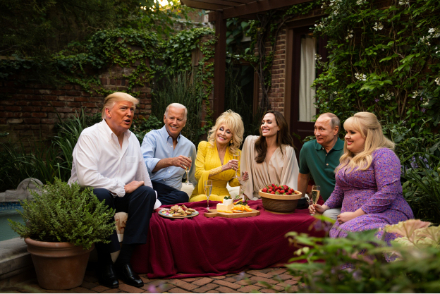
Digital images of a real person that have been created or edited to portray a realistic but false depiction of them. Deepfake image technology is advancing rapidly and it can be difficult to detect, but there are sometimes signs that can help identify lower-tech fake photos and videos.  

How to spot

  • The image is contrary to what you would expect
  • Inconsistencies in the image
  • Blurring, cropped effects or pixilation (small box-like shapes), particularly around the mouth, eyes and neck
  • Skin inconsistency or discoloration
  • Search online to see if the image can be found in other reputable sources

Examples

Donald Trump, Joe Biden, Dolly Parton, Angelina Jolie, Vladimir Putin and Rebel Wilson seated around a picnic table in a garden setting

Figure 1: Image created by RMIT University Library using Reve Image from the prompt:
Donald Trump, Joe Biden, Dolly Parton, Angelina Jolie, Vladimir Putin and Rebel Wilson laughing and having a picnic in a garden.

AI deepfake videos


What are these?

Digitally created or edited videos aimed at influencing public opinion, damage reputations, or commit fraud. High quality fake videos can be created from a single image.


How to spot

  • Inconsistency across a video, such as glitches, sections of lower quality and changes in the lighting or background
  • Irregular blinking or eye movement that seems unnatural or irregular
  • Gaps in the storyline or speech
  • Watch the video at reduced speed as it will be easier to spot mistakes between frames

Examples

Leslie Katz from Forbes provides an overview of the OmniHuman software developed by ByteDance which can create a video from a single image. Please see:

AI deepfake audio


What is this?

Deepfake audio includes: 

  • Voice that is created by AI from a small sample of speech and is deliberately made to sound human. They can be generated as text-to-speech (text converted to audio) or speech-to-speech (audio altered to a different voice). 

  • Other sound that can imitate natural or human-created sound. For example, sounds of nature, music, traffic/transport, etc. 


How to spot

  • Formal, unnatural speech patterns
  • The creator would have been unlikely to have made this comment (if the audio is in the form of speech)
  • Content is difficult to believe
  • The style of speech is inconsistent with the creator
  • Badly synced sound

Example

Audio 1. Sound effect created by RMIT University Library using MyEdit from the prompt: children laughing and playing.